
How to generate an ad graphic
Three modes, one brief and a choice of engine — what to write to get a frame you can advertise with.
Three modes on one screen
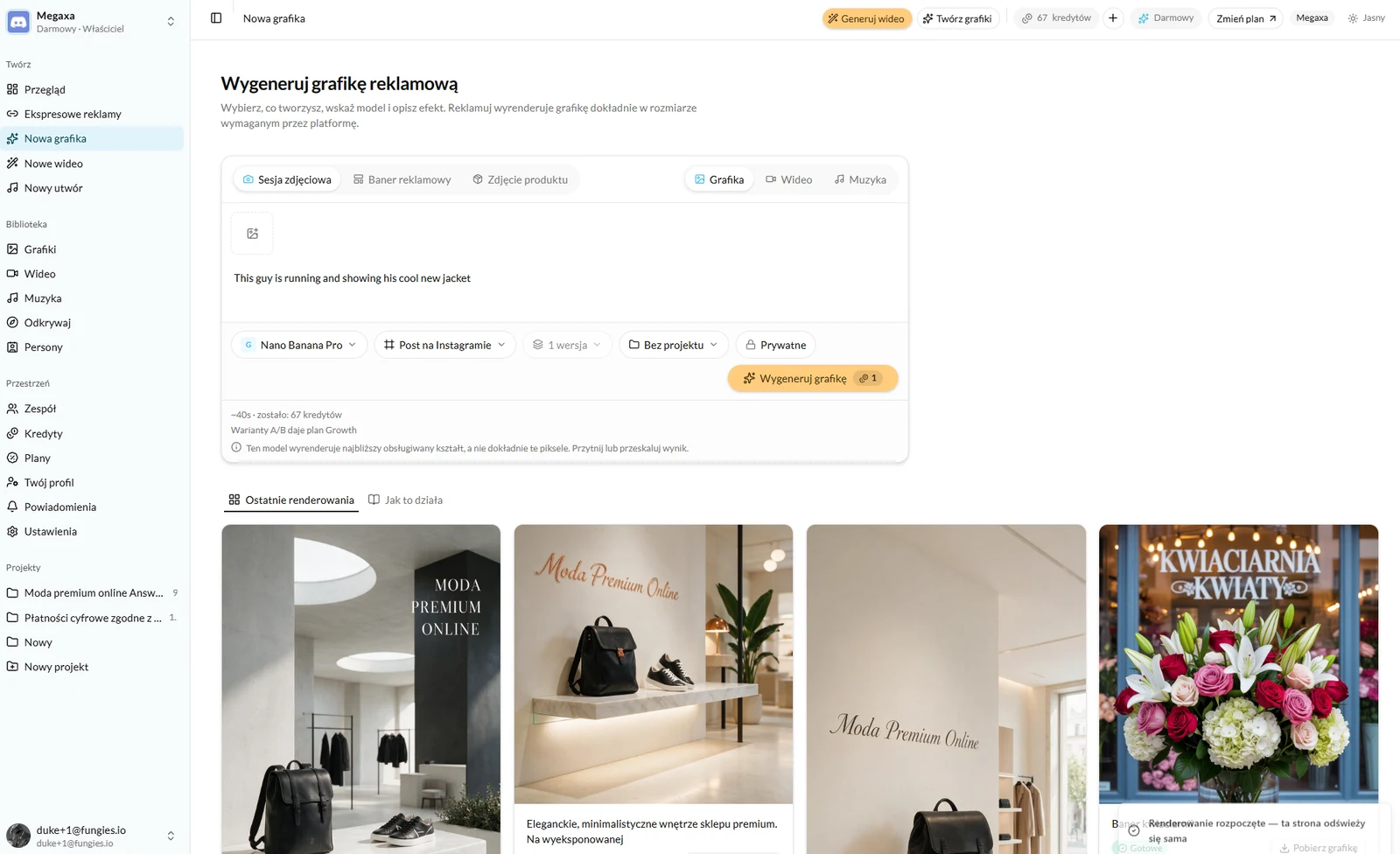
New graphic starts with what you are actually doing. Photo shoot builds a frame from nothing — the product in a room, on a backdrop, in someone’s hands. Ad banner composes a frame with room for text and a logo. Product photo takes your own photograph and changes the background, the light and the surroundings, keeping the product itself.
What to write in the brief
The brief is not a tagline, it is an instruction to a photographer. The model does not know what you sell, but it does know what "window light", "shot from above" and "marble worktop" mean. One sentence is enough.
- Name the product and the material: "a leather backpack", not "our bestseller".
- Say where it stands: a shop interior, a kitchen worktop, a plain backdrop.
- Say what the light is: soft morning, hard sun, warm evening.
- Add the framing if you care about it: from above, at eye level, close on the texture.
- Do not ask for more than one thing at a time. Four conditions in one sentence get met selectively.
Under the brief field the app states how long the render will take and how many credits will be left. Warnings about the selected engine appear there too — that this one treats the size as a suggestion rather than a requirement, for instance.
Choosing an engine, and text in the frame
Switching model is one click and a graphic costs the same on all of them, so there is no reason to choose once and for all. What differs is what they hold: one keeps the weave of a fabric, another the geometry of a room, another the proportions of an unusual banner.
The biggest difference is lettering. If the graphic has to carry words, read them character by character after the render — several engines will drop a diacritic or transpose a letter mid-word. Each model page says plainly how it handles text and when to reach for a different one.
Sizes and versions
You pick the size before rendering, because the frame is composed for it rather than cropped to it afterwards. An Instagram post, a vertical for Reels and TikTok, a horizontal banner — each is its own render and its own credit.
The version count says how many variants of the same brief to produce at once. Four versions is four credits, so start an unfamiliar brief at one: if the brief is wrong, four versions will be wrong in the same way.
Read next
- How to generate an ad videoBrief, engine, length and sound — with examples of spots generated entirely by a model.
- Personas — one face across a campaignA named face built from reference photos, so the same person comes back in every creative.
- The credit system — what you actually pay forOne balance for graphics, video and music. What each render costs and when a credit comes back.
Not covered here?
Write to contact@reklamuj.ai and say what you are trying to do. A person answers, not a bot.
Try it on your own product
Sign up without a card and get 40 credits. Enough for a full set of graphics, video and music for your first few products.